Temple gold or American diamond: choosing a bridal set
The two registers are not traditional and modern. They are answers to two different lights — and most South Indian weddings contain both.
By Lana · · 6 min read
Almost every bride choosing a bridal set is given the same unhelpful frame: temple jewellery is the traditional choice, American diamond is the modern one. It is not a useful distinction, and it leads to the wrong set roughly half the time.
The honest frame is duller and much more use. They behave differently in light, and a South Indian wedding is two or three different lights in one day.
What each does under a light
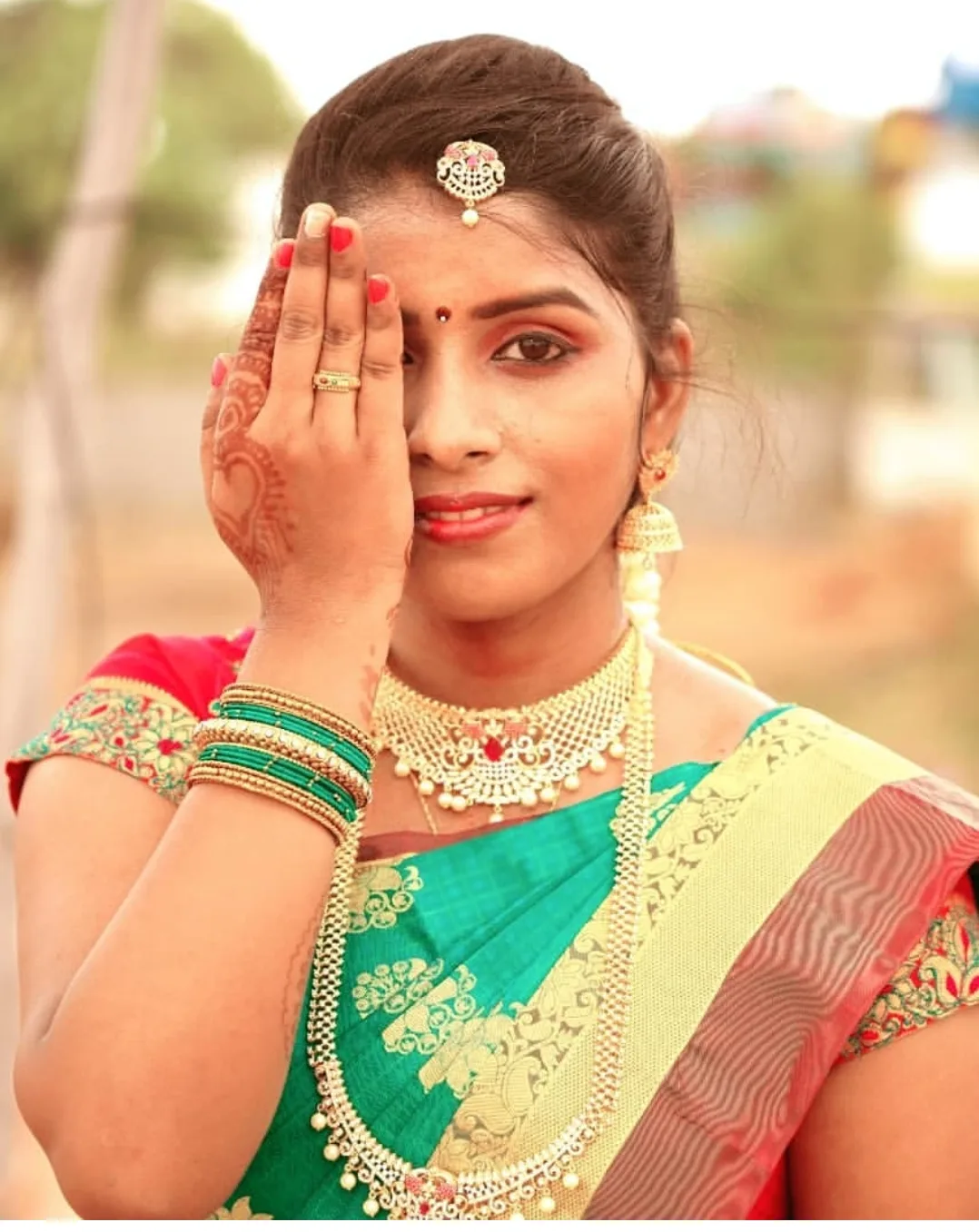
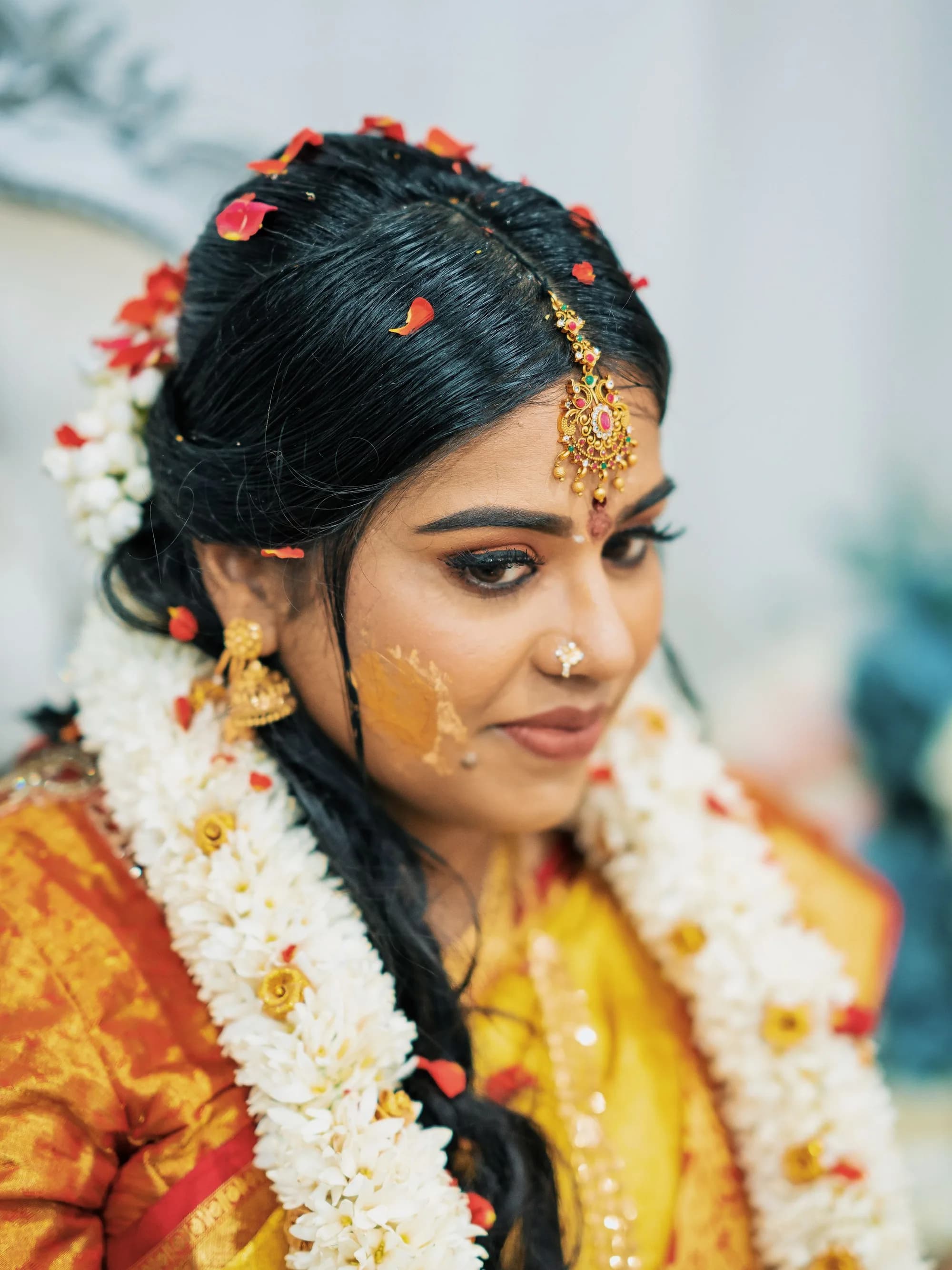
Antique gold — temple jewellery, kemp stones, deity motifs — is warm. Under a lamp, under the fire, under the tungsten in an older hall, it glows: the surface is uneven on purpose, so it catches light in a hundred small places rather than one big one. Under a direct camera flash it flattens somewhat, but it never disappears, because its presence comes from weight and outline rather than from sparkle.
American diamond — white stone, usually with ruby-red and emerald-green alongside it — is the reverse. In warm lamp light it reads slightly grey and does less than you expect. Under flash, and under a videographer's LED panel, it does exactly what the stones are engineered to do.
The ceremony is lit by fire, lamps and a photographer. The reception is lit by a video light. That is the whole reason most brides end up wearing both.
This is also why a set that looked extraordinary in a showroom can look ordinary in a hall. A showroom is lit to sell jewellery. A wedding is not.
The temple wedding case
The older temples are dark stone with very little ambient light, and almost everything you will see of the jewellery in the photographs will have been lit by a flash from six feet away.
In that light, shape survives and detail does not. A haram with a strong silhouette reads from across the mandapam. A finely worked piece whose beauty is in its surface reads as a bright blur.
If the ceremony is in a temple, choose the piece that has an outline from ten feet away, and save the fine work for somewhere it can be seen.
Matching a Kanchipuram silk
The silk decides more than most brides expect, and it decides it before the jewellery does.
- A heavy zari border already carries gold. Antique gold on top of it is a single, coherent statement; white stone against it reads as two decisions that were made separately.
- A darker silk — deep maroon, bottle green, aubergine — gives antique gold something to sit against, which is exactly what it needs, because gold on gold at close range disappears.
- A lighter or pastel silk is where American diamond starts to win. It is the case where white stone has a background to be seen against rather than to compete with.
- The blouse neckline is the constraint nobody checks. A high neck and a close-fitting choker are fighting for the same two inches. Take the blouse measurement to the jewellery decision, not after it.
What the makeup has to do around it
A bridal set is not an accessory to a face. It is roughly a third of what anyone actually looks at.
A heavy gold set at the throat and a long haram down the front pull the eye downward and add a great deal of warmth under the chin. The face has to be built to survive that — usually with a stronger, cleaner lip and a quieter eye, so that there is one focal point rather than three competing ones.
White stone does the opposite. It is cool, it sits flatter, and it leaves the eye with more room to do something. It is the register where a defined eye stops competing and starts balancing.
Chosen separately, the set and the face are two good decisions that do not agree. Chosen together, they are one.
A practical order of decisions
- The silk, because it is usually already chosen and it constrains everything after it.
- The blouse neckline, because it decides whether a choker is even possible.
- The light in the room, which decides the register.
- The set.
- The face, built against the set rather than before it.
Most brides do this in exactly the reverse order, and then spend the morning trying to reconcile four decisions that were each made on their own.
Seeing it on a bride, not on a stand
A necklace photographed on a velvet stand tells you what it is. It does not tell you where it falls, what it does against a neckline, or what it looks like next to a face — and proportion is the one thing a catalogue photograph flattens.
Look at the worn sets before the product frames. It changes which set you choose more often than not.
Lana rents bridal jewellery as well as doing the makeup and the hair, which means the two decisions above can be made in one conversation rather than in two shops. The collection — temple gold, American diamond, chokers and haram — is at bridal jewellery on rent in Trichy, and it travels alongside the makeup for a wedding elsewhere.
- bridal jewellery
- temple jewellery
- american diamond
- jewellery rental
- wedding guides
Keep reading
Enquiries
Have a date in mind?